The Available Quantities
If it is generally correct that clarity about the objective of their endeavors is an essential factor in the success of every activity of men.
The second factor that determines the success of human activity is the knowledge gained by men of the means available to them for the attainment of the desired ends.
The quantities of goods available, at any time, to the various members of a society are set by existing circumstances, and in determining these quantities the only problems they have are to measure and take inventory of the goods at their disposal.
The ideal result of these two varieties of provident human activity is the complete enumeration of the goods available to them at a given point in time, their classification into perfectly homogeneous categories, and the exact determination of the number of items in each category.
In practical life, however, men do not even attempt to obtain results as fully exact as possible in the existing state of the arts of measuring and taking inventory, but are satisfied with just the degree of exactness that is necessary for practical purposes.
To the degree to which men engage in planning activity directed to the satisfaction of their needs, they endeavor to attain clarity as to the quantities of goods available to them at any time.
Wherever a considerable trade in goods already exists, therefore, we will find men attempting to form a judgment about the quantities of goods currently available to the other members of the society with whom they maintain trading connections.
As long as men have no considerable trade with one another, each man obviously has but a small interest in knowing what quantities of goods are in the hands of other persons.
However, as soon as an extensive trade develops and men find themselves dependent in large part upon exchange in meeting their requirements, they naturally acquire a very obvious interest in being informed not only about all the goods in their own possession but also about the goods of all the other persons with whom they maintain trading relations.
As soon as a society reaches a certain level of civilization, the growing division of labor causes the development of a special professional class which operates as an intermediary in exchanges and performs for the other members of society not only the mechanical part of trading operations (shipping, distribution, the storing of goods, etc.), but also the task of keeping records of the available quantities. Thus we observe that a specific class of people has a special professional interest in compiling data about the quantities of goods, so-called stocks in the widest sense of the word, currently at the disposal of the various people and nations whose trade they mediate.
Government activity directed to the determination of the quantities of goods available at any time to a given people or nation is, therefore, naturally confined:
(1) to goods whose quantities are subject only to slight changes, as is the case with land, buildings, domestic animals, transportation facilities, etc;
(2) to goods whose available quantities are subject to such a degree of public control that the correctness of the figures obtained is thereby guaranteed, at least in some degree.
A. Economic Goods
In the two preceding sections we have seen how separate individuals, as well as the inhabitants of whole countries and groups of countries united by trade, attempt to form a judgment on the one hand about their requirements for future time periods and, on the other hand, about the quantities of goods available to them for meeting these requirements.
The task to which we now turn is to show how men, on the basis of this knowledge, direct the available quantities of goods to the greatest possible satisfaction of their needs.
An investigation of the requirements for, and available quantities of a good may establish the existence of any one of the three following relationships:
(a) that requirements are larger than the available quantity.
(b) that requirements are smaller than the available quantity.
(c) that requirements and the available quantity are equal.
We can regularly observe the first of these relationships—where a part of the needs for a good must necessarily remain unsatisfied—with by far the greater number of goods. I do not refer here to articles of luxury since, with them, this relationship seems self-evident. But even the coarsest pieces of clothing, the most ordinary living accommodations and furnishings, the most common foods, etc., are goods of this kind. Even earth, stones, and the most insignificant kinds of scrap are, as a rule, not available to us in such great quantities that we could not employ still greater quantities of them.
Wherever this relationship appears with respect to a given time period—that is, wherever men recognize that the requirements for a good are greater than its available quantity—they achieve the further insight that no part of the available quantity may lose its useful properties or be removed from human control without causing some concrete human needs, previously provided for, to remain unsatisfied, or without causing these needs now to be satisfied less completely than before.
B. Non-economic goods.
In the preceding section I have described the every-day phenomena that result from the fact that requirements for certain goods are larger than their available quantities. I shall now demonstrate the phenomena arising from the opposite relationship—that is, as a consequence of a relationship in which the requirements of men for a good are smaller than the quantity of it available to them.
Suppose that a village is dependent for water on a mountain stream with a normal flow of 200,000 pails of water a day. When there are rainstorms, however, and in the spring, when the snow melts on the mountains, the flow rises to 300,000 pails. In times of greatest drought it falls to but 100,000 pails of water daily. Suppose further that the inhabitants of the village, for drinking and other uses, usually need 200, and at the most 300, pails daily for the complete satisfaction of their needs. Their highest requirement of 300 pails is in contrast with an available minimum of at least 100,000 pails per day. In this and in every other case where a quantitative relationship of this kind is found, it is clear not only that the satisfaction of all needs for the good in question is assured, but also that the economizing individuals will be able to utilize the available quantity only partially for the satisfaction of their needs. It is evident also that partial quantities of these goods may be removed from their disposal, or may lose their useful properties, without any resultant diminution in the satisfaction of their needs, provided only that the aforementioned quantitative relationship is not thereby reversed. As a result, economizing men are under no practical necessity of either preserving every unit of such goods at their command or conserving its useful properties.
Nor can the third and fourth of the above-described phenomena of human economic activity be observed in the case of goods whose available quantities exceed requirements for them.
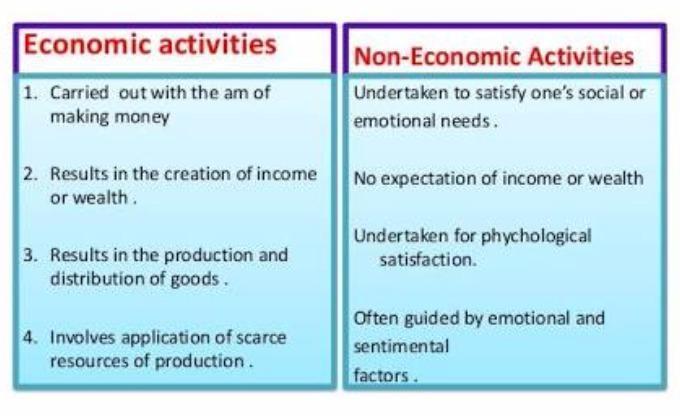
It is clear, accordingly, that all the various forms in which human economic activity expresses itself are absent in the case of goods whose available quantities are larger than the requirements for them, just as naturally as they will necessarily be present in the case of goods subject to the opposite quantitative relationship. Hence they are not objects of human economy, and for this reason we call them non-economic goods.